Repair guide
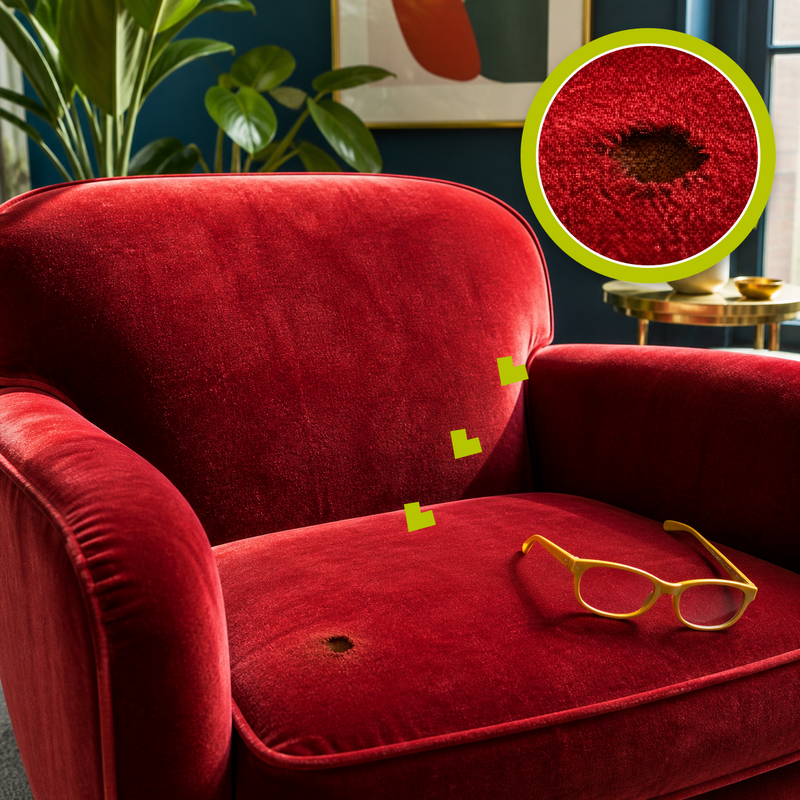
How to fix cigarette burns in a velvet chair armrest?
Cigarette burns in a velvet chair armrest can be repaired when the damage is confined to the upholstery section—even if the burn has removed pile, backing support or a small amount of padding. The Coconix Fabric & Carpet Repair Kit rebuilds those layers with supplied backing fabric, cotton wadding when needed, fabric adhesive and color-blended repair fibers.
First confirm the armrest is completely cool and free of smoke or burning odor. Trim only brittle char, then match the repair fibers from several angles because velvet changes shade with pile direction. Suitable DIY repairs are burns away from a failed seam or damaged frame. Antique velvet, widespread charring and structural damage need specialist repair. Keep the armrest unused for at least 24 hours while the adhesive dries.
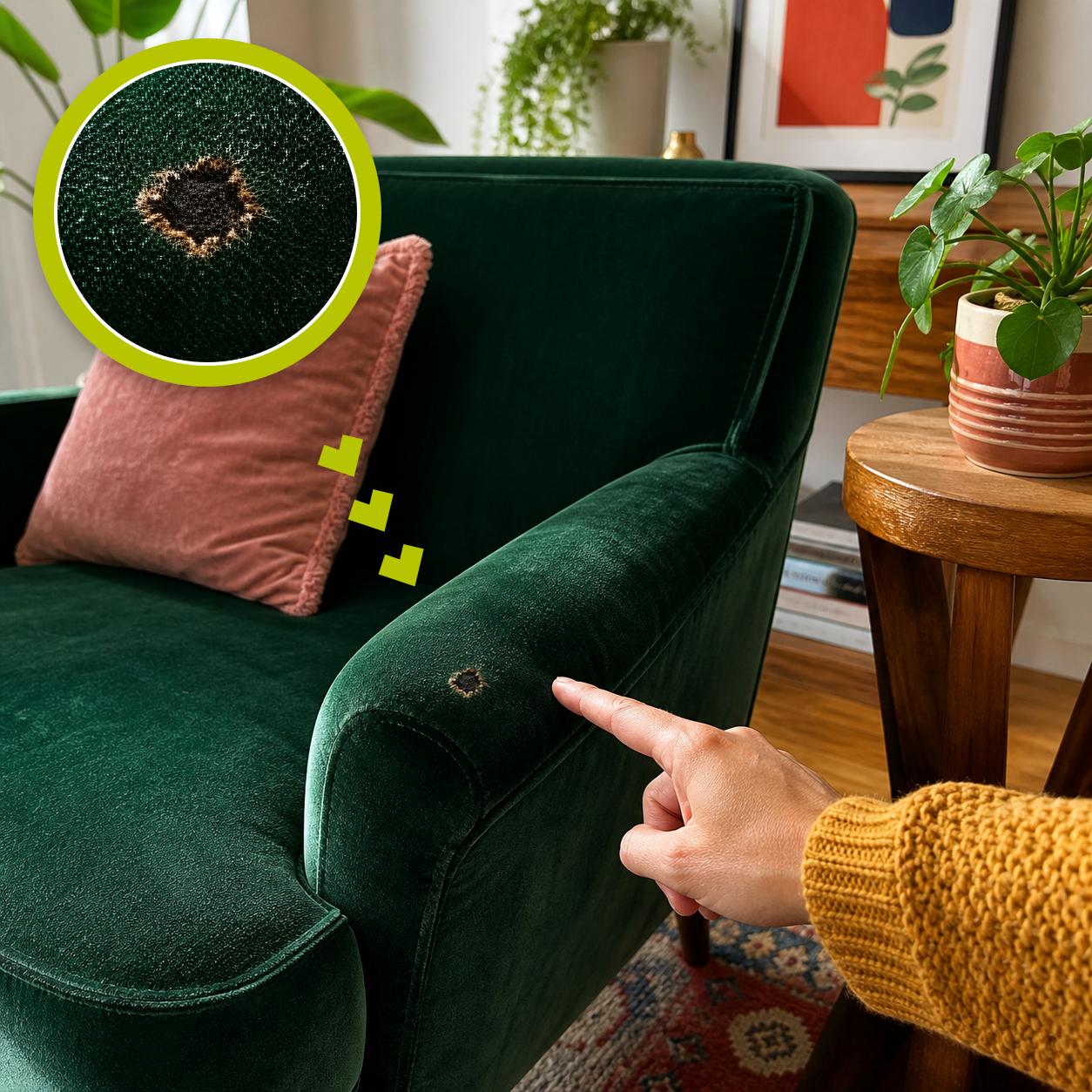
Repair at a glance: cigarette burns on a velvet chair armrest
- Material
- Velvet upholstery
- Damage
- cigarette burns
- Item
- velvet chair armrest
Repair cost
How much does it cost to repair cigarette burns on a velvet chair armrest?
Professional repair estimates by currency
USD
United States dollar
- Smaller repair$150–$300
- More extensive repair$500–$800
EUR
Euro
- Smaller repair€130–€260
- More extensive repair€430–€680
GBP
British pound
- Smaller repair£120–£250
- More extensive repair£400–£700
What does professional repair cost?
What does a DIY repair cost?
$19.95
The kit price shown here is live. One kit can often cover more than one small repair.
See the repair kitWhat changes the repair cost?
- The size, depth and severity of the damage
- The material and whether reinforcement is needed
- The color, grain, texture and finish-matching work
- Local labor rates and whether the item must be transported
Professional prices are indicative ranges from the approved article content and can vary by repairer, location and condition. Request a local quote for an exact comparison.
Difficulty
How difficult is it to repair cigarette burns on a velvet chair armrest?
Time required
How long does it take to repair cigarette burns on a velvet chair armrest?
When cigarette burns on a velvet chair armrest can be repaired at home
When to call a professional for cigarette burns on a velvet chair armrest
Prepare before you start
Materials needed to repair cigarette burns on a velvet chair armrest
-

Coconix Fabric & Carpet Repair Kits
-

Cleaning Solution
-

Cleaning Cloth
-

Cotton Balls (if padding is missing)
-

Scissors (if necessary)


Before repairing cigarette burns on a velvet chair armrest
Watch how to repair cigarette burns on a velvet chair armrest
The written procedure below covers the repair steps shown in the video.
Detailed procedure
How to repair cigarette burns on a velvet chair armrest: step by step
-

Step 1
Preparing the Area
- Confirm that the damaged area is completely cool. Remove only loose threads and brittle burned fibers; do not cut stable surrounding material.
- Clean the cigarette burns and nearby surface with a mild, material-compatible solution and a soft cloth, then let it dry completely.
- If the area beneath the cigarette burns is sunken or missing padding, add a small, even amount of cotton wadding to restore a level base.
-

Step 2
Using the Backing Fabric
- For a hole larger than about 1/4 inch (0.6 cm), cut a piece of backing fabric slightly larger than the opening and round its corners.
- Use the kit spatula to position the backing flat and centered beneath the cigarette burns without stretching the surrounding material.
- Do not use backing for shallow surface burns or smaller damage that does not need additional support.
-

Step 3
Mixing the Repair Fibers
- Use the included Color Mixing Guide when a custom blend is needed, and prepare the selected fibers in the empty mixing jar.
- Add the metal mixing ball, close the jar and shake until the fiber colors are distributed evenly.
- Compare a small sample with the dry velvet chair armrest in its normal lighting before applying adhesive, and adjust the blend if necessary.
-

Step 4
Applying the Fabric Glue
- Apply a controlled amount of fabric glue inside the cigarette burns, beginning at the outer edge and working toward the center.
- Spread the adhesive into a thin, even layer without coating undamaged fibers or leaving a raised pool of glue.
-

Step 5
Adding the Fibers
- Remove the metal mixing ball, stretch the mesh over the jar opening and secure it firmly with the rubber band.
- Hold the jar over the adhesive and tap it gently to sift matched fibers evenly across the glue.
- Cover the adhesive without piling fibers above the surrounding fabric or carpet.
-

Step 6
Finishing Touches
- Press the fibers gently into the adhesive with the spatula and level the repair with the surrounding surface.
- Follow any visible weave, line or pile direction so the matching kit fibers sit naturally.
- Leave the repair undisturbed for at least 24 hours. After the glue is completely dry, blow away or softly brush off only the loose excess fibers.


Protect the result
How to care for a velvet chair armrest after repairing cigarette burns
- After the repair has dried completely, clean it with gentle vacuuming or a soft brush and avoid disturbing the matching kit fibers.
- Keep heat sources, smoking materials and repeated friction away from the repaired area.
- Avoid soaking, harsh solvents, bleach, abrasive cleaners and rough scrubbing tools.
- Inspect the repair periodically; obtain professional help if heat damage, odor, exposed padding or structural weakness becomes apparent.
Aftercare
Troubleshooting
Why does a fabric or carpet repair look patchy or a different shade?
The mixed-fiber ratio is off, loose excess fibers remain, the pile or weave faces a different direction, the fiber density is uneven, or adhesive is showing through.
Use the included Color Mixing Guide, prepare the fibers in the empty mixing jar with the metal mixing ball and shake thoroughly. Compare a small dry sample in normal lighting before adding adhesive. For an existing dry repair, remove only loose excess fibers; align the visible fibers with the surrounding pile or weave and make only the smallest damage-specific correction shown in the matching Coconix How-to.
Why does a fabric or carpet repair edge feel stiff or remain visible?
Excess adhesive, a thick repair boundary, uneven backing or fill, too many surface fibers, exposed adhesive, or pile facing away from the surrounding material.
After full drying, blow away or softly brush only loose excess fibers. Do not add more adhesive to a hard raised edge. If the edge is flexible but visible, correct only the mismatch: remix the fiber shade, align the pile or weave, or use the matching damage guide to level the smallest affected boundary. For the next application, keep adhesive inside the damage, build coverage gradually and level fibers with the surrounding surface.
What should I do if a fabric tear or carpet hole reopens?
The backing did not support the complete opening, localized fill remained low, the surface was used before the adhesive cured, or tension, abrasion or pet activity continued at the same spot.
Take tension off the area and inspect the fibers, backing and localized fill. Remove only loose or unstable threads, clean and dry the area, restore missing localized fill with cotton wadding where needed, place the supplied backing beneath the complete opening and follow the exact tear-or-hole How-to. Keep people, pets, friction and vacuuming away for at least 24 hours while the adhesive dries.
Use specialist repair when the damage crosses a vehicle airbag seam or restraint component, involves a failed furniture frame or mechanism, contains broad contamination, or sits in a large high-tension area that continues pulling apart.
Why does a repair stand out after it dries?
Color, surface level, edge transition or material detail differs from the surrounding area, even if the other three are correct.
View the fully dry repair from normal distance and light, then check color, level, edge and texture separately. Correct only the failed check with the matching Coconix How-to: adjust and dry-test the mix for color, level only where the approved method permits, keep the blend boundary small, or restore the material-specific grain, pile, weave or texture.
Frequently asked questions
Can the Fabric & Carpet Repair Kit rebuild upholstery backing and localized missing fill?
Can patterned or textured upholstery be repaired?
Should I judge a Coconix repair color while it is wet or dry?
Why is drying time part of a successful Coconix repair?
Customer repair story
Burn Be Gone!
Coconix saved my chair and my wallet! The burn mark is completely gone, and I didn’t even break a sweat following the guide. My friends were amazed. Coconix to the rescue!
Individual repair results vary with the damage, material, preparation and application.
Recommended for this method
Best Coconix kit to repair cigarette burns on a velvet chair armrest

Fabric & Carpet Repair Kit - Mix & Match Any Color
$19.95
Repair textile damage with matching fibers instead of replacing the item. The Coconix Fabric & Carpet Repair Kit combines backing fabric, fabric glue and blendable fibers to mend...
More repair possibilities